How Solar Panels Can Help Homeowners Save BIG in the Long Run

We’ve seen them lining rooftops in our neighborhoods, adorning the top of parking structures and out in space generating energy for our astronauts. Solar panels are everywhere nowadays… but what’s the truth about savings when it comes to solar energy? 

The good news is that solar panels are an excellent investment for most homeowners. Benefits for many who go solar include saving money long-term, increasing the resale value of your home, protecting against blackouts, and of course, the undeniable positive environmental impact.

With solar panel costs at a stable decline this past decade and the solar panel industry steadily growing, there’s no better time to get started on your solar journey [1].

Ready to talk to our team of our solar experts? Click the “Free Quote” button at the top of the page for more information!

Upfront costs

Residential solar is being adopted by an increasing amount of homeowners every year. Part of the reason for this boom is that the price of solar has decreased exponentially in the past decade.

Solar panel installation costs have dropped by 60% over the last 10 years. The average residential solar system in 2010 was $40,000, but prices have been cut in half [2].

Residential systems can vary in price depending on the number of panels, your location or storage options you may choose for your home. According to Wood Mackenzie’s energy analysts, the average installation cost for an 8 kWh system is $20,000. However, since many homeowners opt for smaller systems, your upfront costs could be even less [3].

Upfront costs can seem like a lot at first, but there are many ways you can save money. For example, there are many state-level and federal tax incentives available to homeowners across the U.S. – and with Momentum Solar, there are several different financing options to fit any budget! 

Tax incentives

There are many federal and state governmental incentives to assist in buying solar panels for your home. While incentives such as net-metering or local energy credits vary from state to state, there are likely incentives where you live. If you are a homeowner in the Northeast, you can find state-specific incentives here.

On a federal level, the Solar Investment Tax Credit (ITC) is available to all U.S. homeowners. It is a federal tax credit that allows homeowners to deduct up to 30% of their system. For more information on the ITC and to see if you qualify, visit our blog, Everything You Need to Know about the Inflation Reduction Act.

Utilizing these state and federal incentives can help reduce the upfront costs of your home’s system making it easier to afford. Claiming these can also help shorten your payback period so you can start reaping the benefits of the sun sooner.

What is a payback period?

While system costs may seem high at first, keep in mind that for the environment and your wallet, the investment now is more than worthwhile.

A payback period is the time it takes for your solar panels to make up for the initial investment. Solar panels can help you offset installation costs by lowering or even eliminating your electric bill, but it takes time. Payback periods vary greatly depending on the home’s energy output, the amount of solar you bought, and other factors [4].

The average payback period for residential solar panel systems is about 8.7 years, but since there are so many different variables that go into it, a general estimate can be anywhere from six to ten years [5].

Why should I invest in solar panels?

Investing in solar panels can have impactful long-term positive effects on the environment and help you save thousands of dollars throughout the lifetime of your system. “Homeowners who sell their homes within five years of installing a system ‘are almost getting 100 percent of their investment back,’” says a quote from the New York Times [6].

At Momentum Solar, we make it easy to invest in solar panels and to seamlessly begin enjoying the benefits of clean energy. With payback periods at all-time lows and savings at all-time highs, right now is the best time to invest in solar for your home.

Ready to reduce your carbon footprint? Call Momentum Solar today at 1-888-MOMENTUM to learn more about how you can invest in a more sustainable and cost-effective future.


Citations

[1] https://www.seia.org/research-resources/solar-market-insight-report-2022-q4 

[2] https://whatsupnewp.com/2023/01/the-amount-of-solar-home-energy-increased-32-in-2021-heres-how-it-happened/

[3] https://www.woodmac.com/news/opinion/is-the-end-of-high-us-solar-system-prices-in-sight/ 

[4] https://www.cnet.com/home/energy-and-utilities/do-solar-panels-save-money-yes-heres-how/#ftag=CAD-00-10aag7d 

[5] https://www.greenlancer.com/post/solar-payback-period#:~:text=What%20Is%20The%20Average%20Payback,is%20about%206%20%E2%80%93%2010%20years

[6] https://www.nytimes.com/2022/11/26/realestate/solar-panel-cost.html 

How Solar can Protect Against Power Outages

Severe weather is serious and has been a danger to homeowners across America already in 2023. Whether you’re a victim of the Central Texas ice-storms, the worst in 15-years, or a part of the 58 million Americans on alert for severe weather, storms put electrical grids at risk and leave many homeowners without essential functions of their homes [4, 5]. 

Things we may take for granted, such as heat and air conditioning, a running refrigerator and working electrical outlets, may fail at a time of need due to power outages and blackouts. As summer storms and blazing weather quickly approaches, and winter storms begin to fizzle out, power outages are on many homeowners’ minds.

With harsh weather conditions comes power outages. By protecting yourself with solar and battery storage, you can minimize the effects of outages. With solar, you don’t have to worry about being tied to a dying power grid ever again.

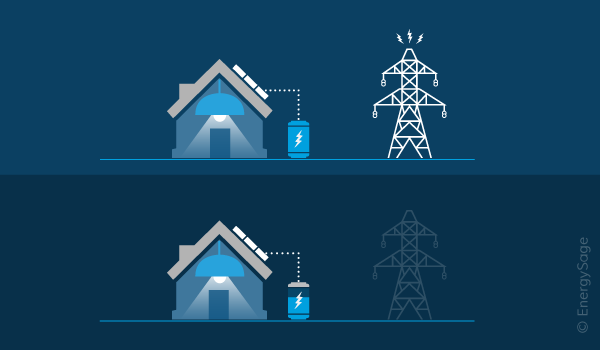
The best way to stay energized during power outages is by making your home a solar island or going off-grid via battery storage. These terms describe a home that has been separated from the utility grid and can stand alone during an outage thanks to banked energy [1]. 

While your neighbors and others are out of power from the utility company, your home will continue to power itself from the battery power you’ve stored up over time. Ready to make this a reality for your home? Call 1-888-MOMENTUM today to speak to a local representative!

Am I off-grid?

One of the biggest things about protecting your home from blackouts with solar is that you need to have a power storage system, such as the Enphase system Momentum offers to all of its customers! Being grid-tied means that your home produces solar energy and uses as much of it as it can, but may still use power from the utility company if needed [1].

https://news.energysage.com/wp-content/uploads/2019/08/07.30.19_Islanding.png

When in a blackout, the grid will also shut down a grid-tied home with solar panels due to safety reasons. Therefore, you will no longer be pulling energy from the sun, and you will no longer be pulling energy from the utility company.  

To be off-grid, or a solar island, you need to have batteries as a way to store excess energy for your home. Momentum Solar’s Enphase battery system is the perfect solution for achieving independence during an extreme weather situation. With completely customizable kWhs of storage for your home, Enphase helps protect you and your loved ones in a power outage.

Ready to protect your home with Enphase? Click the “Free Quote” button on the top of the page for more information.

How long can I power my home?

If you don’t need air conditioning or heat, or your heat runs off of gas, your home can easily run main functions for 24 hours based on 10 kWh of storage [2]. The Energy Information Agency says that the average power outage is less than six hours, so your home will have more than enough power for a standard power failure event [3].

For more detailed information visit our previous blog, How long can your solar battery power your home in an outage?

These numbers depend on a few things, such as how much storage you opt for and what the normal output for your home looks like. Momentum Solar’s partnership with Enphase offers the Encharge 10 with 10.1kWh as well as the Encharge 4, which provides roughly 4 kWh of storage. You can stock up with as many as you’d like and allow your home the capability of being off-grid whenever you need it most! You can even use the battery system to switch to stored energy during peak usage hours. This means you’ll be able to save even more on your monthly utility bill!

Momentum Solar makes it easy to be off-grid. With our Enphase partnership, you can store backup power that is easy to use and keep important appliances running smoothly while reducing your carbon footprint. Your home will be able to draw energy from your storage system as well as continue to bank in energy during a power outage.

Ultimately, investing in solar batteries and storage solutions helps you save a lot of money long term. From spoiled food to frozen pipes, being able to maintain your home reliably is essential with today’s occurrences of extreme weather and can help save you money.

From hurricanes to wildfires, no matter what type of climate threats you face, Momentum Solar can help you keep you and your family safe. To get started with a Enphase battery system or to learn more, call 1-888-MOMENTUM today.


Citations:

[1] https://www.cnet.com/home/energy-and-utilities/do-blackouts-affect-homes-with-solar-panels-sometimes/ 

[2] https://www.solar.com/learn/how-long-can-a-battery-provide-power-during-an-outage/

[3] https://www.eia.gov/todayinenergy/detail.php?id=43915 

[4] https://www.kxan.com/news/local/your-photos-and-videos-help-show-the-scope-of-the-historic-2023-central-texas-ice-storm/ 

[5] https://abcnews.go.com/US/100-million-americans-30-states-alert-severe-weather/story?id=97217487 

Everything You Need to Know about the Inflation Reduction Act

Tax season is right around the corner! So if you’ve just installed solar panels with us, or are thinking about solar for your home, Momentum Solar has the breakdown on everything you need to know about the Inflation Reduction Act.

The Inflation Reduction Act (IRA) is a United States federal tax incentive and is one of the most significant energy public investment proposals in history. Set to boost the economy for working-class families, the IRA aims to tackle the climate crisis by expanding targeted tax incentives that promote clean energy technologies such as batteries and solar [2]. 

Through the IRA, the Biden administration extended the Investment Tax Credit (ITC) through 2025 [3]. With this, comes many benefits to the solar industry as a whole with a five-year growth outlook increasing by 40% [1].

Thinking about if solar panels are right for your home? Click the “Free Quote” button on the top of the page for more information or call 1-888-MOMENTUM to talk to a local sales representative!

What is the Investment Tax Credit?

The Solar Investment Tax Credit (ITC) is a federal tax credit that supports the growth of solar energy in the U.S. It was enacted in 2006, and since then, the U.S. solar industry has grown more than 200%. With the government investing in clean energy, the ITC has created hundreds of thousands of jobs and invested billions of dollars in the economy [4].

The ITC is a tax credit provided by the federal government to individuals installing solar panels on their residential property [4]. You can claim the ITC for the tax year that your solar panels were installed. In August 2022, when the IRA was passed, the ITC raised its credit from 26% to 30% [3]. 

Let’s take a step back for a minute. What even is a tax credit? How do I claim it? 

“​​A tax credit is a dollar-for-dollar reduction in the amount of income tax you would otherwise owe” [3].

The tax credit provides a refund on your federal income tax for a percentage of the cost of your solar system [3]. To claim the ITC on your federal income tax for 2022, you need to fill out Form 5695 for the Internal Revenue Service [5]. As always, make sure to do your own research or talk to a tax expert or accountant when filing your taxes. For even more information, visit our previous blog here.

Am I eligible for the ITC?

Here are the eligibility requirements for the ITC, according to information from energy.gov [3]:

  • Your solar system was installed and placed in service before December 31, 2034
  • Your solar system is located at a residence belonging to you in the U.S.
  • Must own the system either through financing or cash purchase

How does the IRA affect someone with solar?

Residential solar has been record-breaking all around. Even amid supply-chain constraints and permit delays, residential solar installations have been increasing with 23,000 in Q3 of 2022 alone [1]. For more information on residential solar’s 2022 performance, visit our latest blog, The Solar Revolution in the US.

The IRA helps homeowners across America take advantage of the ITC. With its expansion, you can now get reimbursed for your installation costs even more. Not only is this credit assisting homeowners in saving tons of money, but it’s also helping the environment by fostering a cleaner future.

The ITC isn’t the only governmental financial incentive. Several state governments have their own tax incentives and net metering opportunities offered to local homeowners. You can find more information by checking out our coverage areas page and clicking on your state. If you’re a homeowner in the Northeast, you can visit our recent blog here for state-specific information.

If you’re a Momentum Solar customer from 2022, now is the time to get started on your tax returns as April 18 is just around the corner! If you’re thinking about solar for 2023, keep in mind the ITC is a great way to cut costs. Need some help deciding if solar is right for you? Visit our blog, Looking Toward the Future of Solar to get the low-down on solar in 2023.

Ready to get some panels on your roof? Click the “Free Quote” button on the top of the page or call us at 1-888-MOMENTUM!


Citations:

[1] https://www.woodmac.com/news/opinion/the-us-solar-industry-waits/

[2] https://www.whitehouse.gov/briefing-room/statements-releases/2022/08/19/fact-sheet-the-inflation-reduction-act-supports-workers-and-families/ 

[3] https://www.energy.gov/eere/solar/articles/federal-solar-tax-credit-resources 

[4] https://www.seia.org/initiatives/solar-investment-tax-credit-itc 

[5] https://www.irs.gov/forms-pubs/about-form-5695 


The Solar Revolution in the US

Solar output rises with the sun every day. Homeowners across the country are noticing the financial and environmental advantages of switching to green energy. The U.S. is increasingly using renewable electricity resources, including solar, each year. Homeowners like you who decide to switch to clean energy make a significant impact in neutralizing natural gasses in the country.

With a record-breaking amount of installs in 2022 and the government expanding tax incentives like the Inflation Reduction Act (IRA), the U.S. is producing more energy than ever before. 

Ready to do your part in saving the environment? Check out our solar plans or call us at 1-888-MOMENTUM today!

Solar is Booming in the US

According to the Energy Information Agency, or EIA, the U.S. is forecasted to have one-fourth of its energy produced by renewable resources such as solar or wind within a two-year span. This renewable power generation reduces the electricity supply from coal and natural gas [1]. These factors make the U.S. more independent and help foster a sustainable environment. 

The Federal Energy Regulatory Commission (FERC) takes it a step further, saying that in the next three years, solar energy will make up nearly two-thirds of U.S. energy additions. According to the FERC, U.S. solar capacity will nearly double from December 2022 to November 2025, and between now and then, natural gas addition will almost be completely counterbalanced [2].

In Q3 of 2022, the U.S. solar industry had more than 5GWh of energy storage. This has been the highest Q3 figure on record and is half of the entire capability of storage installed in 2021 [3]. You might be thinking that these numbers are from large corporations implementing solar energy, but residential homes have a major impact on the solar industry. With record numbers in categories such as solar panels shipped, quarterly installs and energy output, residential solar is putting in good work in the U.S [7].

Residential Solar’s Impact

With more than 23,000 installs in Q3 of 2022 alone, residential solar is breaking records of its own producing 375MWh of solar energy. This is equal to the CO2 emission produced by 648 homes’ electricity use for one year [6]. The previous record was made in Q2 of 2022 [3]. 

To join in on the clean energy revolution, click the “Free Quote” button on the top of the page or call us at 1-888-MOMENTUM!

The state leaders in residential solar were California and Texas, both of which Momentum Solar and its sister companies have offices in Texas has been the most fast-paced solar growth area in the U.S., and you can read about its incredible adoption of solar power in our recent blog Looking Toward the Future of Solar. 

Don’t worry if you’re not from a traditionally “sunny” state! The savings don’t discriminate based on location – in fact, solar panels can even generate energy on cloudy and overcast days. You can read more about how solar can save you thousands in our blog from last week, Your Guide to Solar in the Northeast.

To see how Momentum Solar can help you, check out our service areas or contact us today by clicking the “Free Quote” button at the top of the page.

Why Residential Solar is Booming

Rooftop solar panels in residential neighborhoods have been growing rapidly over the past 10 years. On average, solar has had an annual growth rate of 33% [4], which is more than other booming industries such as the international airlines, electric vehicle manufacturing or commercial banking industries [8]. According to data from 2021, there is enough solar energy stored to power 23 million homes [5].

There are many factors that are causing the residential solar boom. With carbon offsetting and sustainability efforts being some of the government’s goals, the government has set up incentives for homeowners at the federal and state levels. 

One of the biggest factors is the Inflation Reduction Act (IRA) which, under the Biden administration, expanded tax credits regarding solar. The ITC federal tax credit offers savings for solar-paneled homeowners and it recently increased from 26% to 30% [5].

Additionally, cost plays a major role in the increase of residential solar. Solar panel installation costs dropped by 60% over 10 years making solar more accessible to homeowners across America.

Residential solar energy is becoming increasingly more common, and Momentum Solar is here to help you get started. To see pricing in your area or to speak to a local sales representative call 1-888-MOMENTUM today.

Citations:

[1] https://www.eia.gov/todayinenergy/detail.php?id=55239 

[2] https://www.pv-tech.org/solar-to-dominate-us-capacity-additions-73gw-expected-through-2025/ 

[3] https://www.energy-storage.news/us-sets-another-record-for-quarterly-energy-storage-installation-figures/ 

[4] https://www.seia.org/solar-industry-research-data

[5] https://whatsupnewp.com/2023/01/the-amount-of-solar-home-energy-increased-32-in-2021-heres-how-it-happened/ 

[6] https://www.epa.gov/energy/greenhouse-gas-equivalencies-calculator#results 

[7] https://www.eia.gov/todayinenergy/detail.php?id=53679 

[8] https://www.ibisworld.com/united-states/industry-trends/fastest-growing-industries/ 

Your Guide to Solar in the Northeast

Many homeowners in the Northeastern U.S. are gearing up for power outages and cold nights this winter, and many wish they had solar. There are countless reasons why now is the perfect time to get started on your solar journey. With state and federal incentives, rising electricity costs, and our dedicated team members at Momentum Solar ready to help you make the transition to clean energy, it’s never been easier to switch.

The Mid-Atlantic and New England regions are great places to have residential solar. In fact, New England has the highest solar adoption area per capita [1]. Momentum Solar is proud to serve these areas with offices in Connecticut, Massachusetts, New York and New Jersey. 

Feel free to check out our service areas, the financial plans available to you, or contact us today by clicking the “Free Quote” button on the top of the page or calling us at 1-888-MOMENTUM!

Why Should You Go Solar?

Rising energy bills in the U.S. are a great reason to consider when debating switching to solar. According to economists, energy bills will continue to spike and are not forecasted to fall any time soon. Natural gas prices are at a 14-year high in America and moving forward with renewable energy efforts is the best way to help [27].
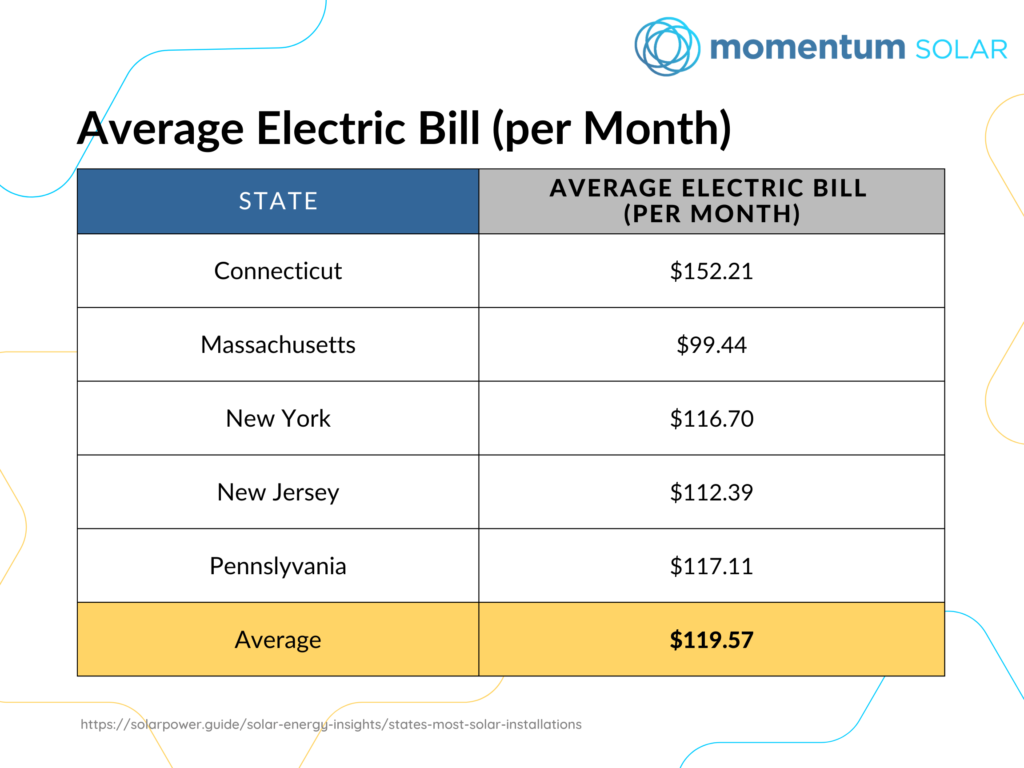
There are many state-funded incentive programs that make the decision to go solar much easier. Not to mention, any homeowner in the United States can benefit from the federal Inflation Reduction Act (IRA) which extended the time period of the Investment Tax Credit or ITC. 

This solar tax credit which is sometimes known as the Residential Clean Energy Credit is a 30 percent deduction from the cost of installation from your federal taxes. It is available until 2033 after which it will drop to 26 percent, in 2034 after which it will drop to 22 percent and will end in 2035. The ITC can be claimed by residential and commercial systems, and currently,  there is no limit on its value [21].

Now that you get the gist of what solar prices in the Northeast look like, here is the state-by-state breakdown! To talk to a local sales representative about solar options in your area, call us today at 1-888-MOMENTUM

Connecticut

With Connecticut energy costs going through crazy spikes and the state offering many incentives now is a great time to think about solar if you’re a Connecticut homeowner [28]. The Connecticut Clean Air Act helps guide more people toward solar and has disallowed Homeowners Associations from blocking solar installations in a recent provision [29].

Here are some great state incentives in Connecticut right now:

Connecticut Green Bank Solar for All Program: “You don’t have to be among the wealthy elite to benefit from solar power in Connecticut. The state offers a power purchase agreement (PPA) to eligible low-income households, which allows them to access solar energy at a reduced rate” [26].

Connecticut Green Bank Residential Solar Investment Program (RSIP): “This program offers incentives and cash rebates for both owners and lessees of solar power, which is somewhat uncommon (most states only offer these benefits for those who purchase a system, rather than lease it). Under this program, owners of solar systems can enjoy a cost reduction of $0.426 per installed watt based on system size. Those who lease their system can get compensation of $0.30 per kilowatt hour generated” [26].

The Property Tax Exemption for Renewable Energy Systems: The state has also passed tax breaks to residents willing to switch to solar. It helps owners with a sales tax when purchasing the systems. It also exempts homeowners from property tax on the increased value post-solar install [26].

For more information about other Connecticut solar benefits and incentives, visit here.

Massachusetts

Despite the misconception that the state doesn’t get enough sunlight for solar panels, Massachusetts happens to be an excellent solar spot [23]. Electricity rates in the state are expected to increase between 43 percent and 64 percent this winter [24] and capitalizing on sunshine is starting to make more and more sense in Massachusetts. 

Amid the rising energy cost crisis, there are plenty of solar incentives offered in Massachusetts to make the transition cheaper and easier:

Solar Massachusetts Renewable Target (SMART)

“One of Massachusetts’ most exciting solar developments is the SMART program. With this incentive, the State of Massachusetts pays Eversource, National Grid, and Until customers a fixed rate per kilowatt hour (kWh) of solar energy produced for 10 years. For systems under 25 kilowatts (kW), the rate ranges from 19 to 31 cents per kWh, depending upon your location and utility. In addition, the state also provides higher incentive rates for low-income customers or those who install battery storage to pair with their solar panel system, making solar power more accessible to more customers in the Bay State” [22].

Net metering in Massachusetts

When solar homeowners receive bill credits from their utility for the energy that they send back to the grid, they are benefitting from one of the best incentives in solar. [22]

For more information about other Massachusetts solar benefits and incentives visit here and here.

New York

According to the Solar Energy Industries Association (SEIA), New York is currently ranked eleventh in the country for solar installations and solar is getting more and more popular every day [25]. There are so many great incentives offered by the state, and here is our breakdown:

The Megawatt Block Incentive Structure: “The program provides an up front dollars-per-watt ($/W) rebate for both commercial and residential solar panel systems. The size of your subsidy depends on the size of your system, the current Megawatt block and your region. As of January 2022, the incentive values range from $0.20/W (ConEdison) to $0.50/W (Upstate)” [5,6].

New York net metering: “a crucial policy that ensures you get paid a fair price for the solar electricity that you send into the grid. Any credits for excess solar power that you accrue are stored in a “credit bank” and can be used in future months (usually winter) if your solar energy system produces less electricity” [6].

Net metering programs in New York:

For more information about other New York solar programs and incentives click here.

New Jersey

Did you know that New Jersey is ranked seventh in the country for solar energy adoption? Over the last five  years, solar prices in the state dropped by 45 percent, and by 2030, 50 percent of the state’s electricity will come from renewable energy [7,8].

The state offers many incentives, and we’re here to break them down for you:

Solar Renewable Energy Credits (SRECs): “Compensation per kilowatt-hour (kWh) produced by the system. [9] (Varies by market value.)” [10].

Solar Investment Property Tax Exemption: “Property tax exemption on the added home value from the rooftop solar system” [11].

Solar Panel System Sales Tax Exemption: “6.625% home solar system state sales tax exemption” [12,13].

For more information about New Jersey solar programs visit here.

Pennsylvania

In Pennsylvania, over 7 million residents were affected by blackouts from 2008 to 2017 [14]. This staggering number could be why so many in the Keystone State are choosing clean energy. Solar power is a great resource that can help you stay safe during hazardous winter weather when coupled with a comprehensive battery storage system[15]. In the last five years, Pennsylvania’s solar prices dropped 43 percent, and the data shows that solar power in Pennsylvania is 10 percent more effective than in other states [16, 17]. The estimated 20-year savings in Pennsylvania is over $23,000, making solar in Pennsylvania more than worth it [19].

The state of Pennsylvania offers homeowners a couple of different solar incentives. Below you’ll find helpful information on both:

Pennsylvania net metering: “This is one of the most important policies for solar in Pennsylvania, as in many other states, because it governs how your residential system interacts with the grid. Net metering allows you to sell excess solar electricity back to the utility at the same price at which you would buy it. The ability to send electricity back to the grid is key, as it allows homeowners to “bank” their solar energy when production is up and use it when they need it later on. PECO Energy offers the top utility net metering program in Pennsylvania” [20].

Solar Renewable Energy Certificates (SRECs): “This program enables Pennsylvanians to sell the SRECs that their panels generate. In 2021, the going rate for these credits was between $24 and $41. At the lower end of this range, an 8-kilowatt (kW) system that generates 8 MWh per year could make an extra $192 per year from selling SRECs” [20].

For more information on Pennsylvania solar incentives click here.

What Does This Mean for You?

If you’re a homeowner in any of these states, we hope you found these resources helpful when deciding to go solar. There are many different ways to save, and Momentum Solar is here to help you find the best price whether you’re in Florida, Texas, New York or any of the other eight states we operate in!

To begin our simple free quote process, click the link above – or contact a dedicated solar specialist in your area by calling 1-888-MOMENTUM today. 


Citations:

[1] https://solarpower.guide/solar-energy-insights/states-most-solar-installations

[2] https://www.woodmac.com/news/opinion/is-the-end-of-high-us-solar-system-prices-in-sight/

[3] https://news.energysage.com/how-much-does-the-average-solar-panel-installation-cost-in-the-u-s/

[4] https://www.solar.com/learn/inflation-reduction-act/ 

[5] https://www.nyserda.ny.gov/All-Programs/NY-Sun/Contractors/Dashboards-and-incentives 

[6] https://www.energysage.com/local-data/solar-rebates-incentives/ny/

[7] https://www.seia.org/state-solar-policy/new-jersey-solar 

[8] https://www.nj.gov/dep/aqes/opea-clean-energy.html 

[9] https://www.njcleanenergy.com/srec 

[10] https://www.srectrade.com/markets/rps/srec/new_jersey 

[11] https://programs.dsireusa.org/system/program/detail/3100 

[12] https://programs.dsireusa.org/system/program/detail/219 

[13] ​​https://www.state.nj.us/treasury/taxation/ratechange/su-overview.shtml

[14] http://electricalsector.eaton.com/forms/BlackoutTrackerAnnualReport 

[15] https://www.washingtonpost.com/business/energy/winter-blackouts-highlight-need-for-clean-energy/2023/01/19/85aa500e-97ef-11ed-a173-61e055ec24ef_story.html 

[16] https://www.seia.org/state-solar-policy/pennsylvania-solar 

[17] https://decisiondata.org/solar-by-state/pennsylvania/ 

[18] https://www.seia.org/initiatives/solar-investment-tax-credit-itc 

[19] https://www.energysage.com/local-data/solar-panel-cost/pa/ 

[20] https://www.energysage.com/local-data/solar-rebates-incentives/pa/ 

[21] https://news.energysage.com/solar-tax-credit-explained/  

[22] https://www.energysage.com/local-data/solar-rebates-incentives/ma/ 

[23] https://www.mass.gov/solar-information-programs 

[24] https://www.cnet.com/google-amp/news/massachusetts-solar-panels/ 

[25] https://www.ecowatch.com/solar/worth-it/ny 

[26] https://www.forbes.com/home-improvement/solar/solar-panel-pricing-incentives-connecticut/ 

[27] https://www.usatoday.com/story/money/personalfinance/2023/01/24/electricity-prices-inflation/11089430002/ 

[28] https://ctmirror.org/2023/01/03/ct-energy-winter-shortage-natural-gas/ 

[29] https://energynews.us/2023/01/18/connecticut-homeowner-associations-can-no-longer-block-solar-installations/


Looking Toward the Future of Solar

As 2022 comes to a close, there is a lot to think about when it comes to family and your home. Electricity costs continue to rise and likely won’t ever stop, but we’re here to share how millions of Americans are saving billions of dollars by switching to solar. 

There has been a lot of number crunching happening behind the scenes that show the breakdown of solar power’s rise to become more commonplace. In fact, green energy like solar power is expected to outpace “dirty” energy in 2023 [5].

A big player in generating these statistics is the Energy Information Administration (EIA), which says that by October 2022, renewable energy provided nearly 23 percent of US energy. Solar power has had a considerable hand in the rise of renewable energy with October 2022’s output being nearly 32 percent greater than October 2021 [1].

What does this mean for you? This means there is no better time to think about investing in solar. Are you ready to go solar already? Contact us today by clicking the “Free Quote” button on the top of the page or calling us at 1-888-MOMENTUM!

Among some of the biggest contributors to the surge in renewable energy are Momentum Solar coverage areas like California, Florida, Texas and the northeast. The EIA forecasts that Texas will get the biggest share of its electricity from renewable energy like solar [1].

You Can Go Solar No Matter Your Location

Solar panels can help you save money and the environment from anywhere in the US. Whether you’re from sunny states like Florida, California or Texas or from up north in New Jersey or Massachusetts, we’ve got you covered.

In Q2 of 2022, California, Texas and Florida led the way in solar output. They weren’t the only states in the top 10 that Momentum Solar covers with New Jersey and Massachusetts being in 8th and 9th place, respectively [2].

To talk to a local sales representative about solar options in your area, call us today at 1-888-MOMENTUM. 

Solar Panels Are Saving Millions of People Billions of Dollars

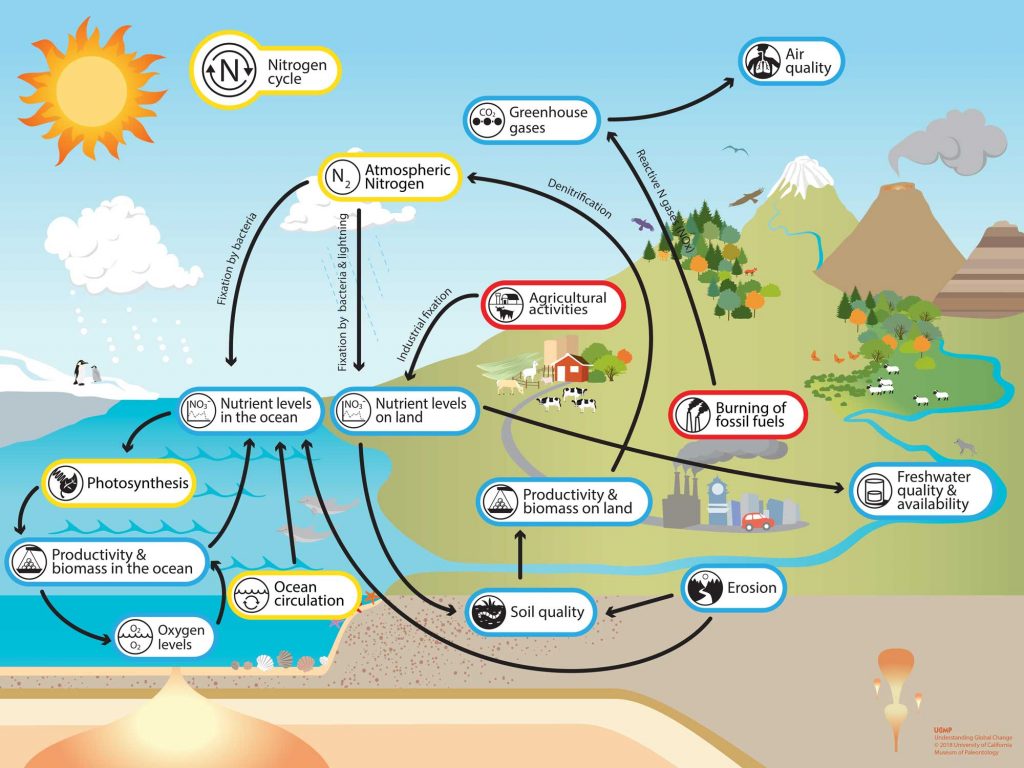
Homeowners around the U.S. find that solar is a great way to save on their electricity bills while also helping the environment. The spread of solar has not only allowed homeowners across the states to pocket extra cash but has also shown decreases in pollutants such as nitrogen oxides and sulfur oxides which are emitted through the use of fossil fuels [3].

https://ugc.berkeley.edu/background-content/nitrogen/

Texas has been one of the fastest-paced growth areas in the solar industry. In 2023, Texas’ natural gas output is expected to fall by 6 percent and its renewable energy to rise by 7 percent [4]. In total, Texan businesses and residents will save $11 billion this year, and they had an average monthly savings of $925 million in 2022 [3].

Momentum Solar loves serving Texan homeowners, as we have offices in Dallas, Austin, San Antonio and Houston.  If you’re looking to capitalize on the savings, you can contact our dedicated solar specialists at 1-888-MOMENTUM.

Not in Texas? We’ve still got you covered. Whether you’re living in Boston, Connecticut, Florida, Arizona or anywhere in between, there is still plenty of sunshine and savings to go around.

There are a lot of factors that go into solar energy aside from the amount of sunshine, and the savings can be different from state to state based on rising energy prices and tax incentives.

To learn about some incentives that may affect you, visit our past blog posts here.

How You Can Go Solar in 2023

Momentum Solar is here to make your transition to solar energy as seamless and headache free as possible. 

To begin our simple free quote process, click the link above – or contact a dedicated solar specialist in your area by calling 1-888-MOMENTUM today. 


Citations:

[1] https://www.eia.gov/outlooks/steo/pdf/steo_full.pdf

[2] https://www.statista.com/statistics/183531/renewables-in-the-us-leading-states-in-pv-capacity/

[3] https://www.ideasmiths.net/wp-content/uploads/2022/10/IdeaSmiths_CFT_ERCOT_RE_FINAL.pdf

[4] https://twitter.com/EIAgov/status/1600189441988968449?ref_src=twsrc%5Etfw%7Ctwcamp%5Etweetembed%7Ctwterm%5E1600241363366211584%7Ctwgr%5Ec0ccb9b78675ca957d9499aa0b54d2cdc16360a9%7Ctwcon%5Es2_&ref_url=https%3A%2F%2Fnews.yahoo.com%2Ftexas-more-electricity-solar-wind-103243123.html 

[5] https://www.ecowatch.com/wind-solar-outpace-nuclear-coal.html

Terms & Conditions - Privacy Policy

We use cookies to make our site work well for you and so we can continually improve it.
The cookies that are necessary to keep the site functioning are always on.